

Digital marketing isn’t just an optional business strategy—it’s a critical tool for businesses aiming to thrive in today’s competitive environment. Yet, many small and medium-sized businesses (SMBs) struggle to determine where to focus their efforts for maximum impact.
This is where Asset Digital’s Digital Marketing Strategy Framework comes in—a research-backed pathway designed to help small businesses achieve faster growth, greater profitability, and sustained competitiveness.
In this article, we’ll explore the framework, breaking down its stages and highlighting actionable steps your small business can take to accelerate their digital marketing growth.
What Is Digital Marketing Maturity?
Before diving into the Asset Digital Maturity Model Assessment it’s helpful to understand the concept of digital marketing maturity. This term refers to the evolution of an organization’s capabilities in leveraging digital marketing to achieve business goals. It’s a process that follows the business as they move from experimenting with basic digital marketing strategies to becoming a market leader with fully optimized and innovative digital campaigns.
For SMBs, understanding digital marketing maturity is key to maximizing return on investment (ROI). By identifying your business’s current stage and implementing targeted strategies, you can better align marketing efforts with measurable outcomes, such as increased customer engagement, improved conversion rates, and sustained revenue growth.
Why Does Digital Marketing Maturity Matter?
For small and medium-sized businesses, every dollar spent on marketing needs to deliver measurable results. The competitive landscape is tougher than ever and improving digital marketing maturity offers SMBs the tools and strategies they need to stand out, grow, and thrive.
Achieving digital marketing maturity provides businesses a competitive edge, improving profitability, and ensuring long-term sustainability.
Businesses that prioritize digital marketing maturity can:
1. Be More Competitive:
By focusing on digital marketing maturity SMBs can tap into new growth opportunities, positioning themselves as industry leaders. Staying ahead of trends is crucial, and businesses that embrace emerging tools and technologies—such as automation, AI, and advanced analytics—gain a distinct advantage over competitors.
The ability to quickly implement innovative strategies and adapt to consumer behavior ensures the digitally mature business can more effectively stay top of mind for their target audience, even as market dynamics shift.
2. Be More Profitable:
A business that has attained digital marketing maturity is better able to maximize the value of every marketing dollar. By tracking key performance indicators (KPIs), refining strategies through data insights, and optimizing campaigns, businesses can minimize wasted spending and boost ROI. Whether it’s through more effective lead generation, improved conversion rates, or cost-effective advertising, digital marketing maturity empowers SMBs to focus on high-return activities that drive revenue and ensure sustained profitability.
3. Be More Resilient:
The world of business is constantly changing, from shifts in consumer preferences to unexpected economic challenges. A data-driven digital marketing maturity strategy provides SMBs with the agility they need to quickly pivot when necessary.
By continuously analyzing and refining marketing efforts, businesses can stay in tune with customer needs, predict market changes, and adjust their tactics in real time. This resilience not only protects the business during uncertain times but also creates opportunities for growth in any environment.
Digital marketing maturity is an insurance policy for surviving and thriving in today’s digital-first world. By investing in the right strategies and tools, businesses can secure a profitable path forward now and in the future.
| Take this Digital Marketing Maturity Assessment: Gain New Insights to Grow Your Business |
Adapting Proven Strategies for Digital Marketing Maturity
Research by Boston Consulting Group (BCG) and Google demonstrates that companies that actively mature their digital marketing achieve exponential gains. These organizations experience improved ROI, faster growth, and enhanced competitiveness. However, the frameworks used in these studies were designed with global corporations in mind—companies with extensive budgets, teams, and resources.
Recognizing this gap, Asset Digital Communications has taken the core principles of the BCG and Google digital marketing maturity model and tailored them specifically for small and medium-sized businesses (SMBs). This adaptation means that SMBs now have access to a practical, scalable methodology that reflects the unique challenges and opportunities that come with being a small business.
By focusing on the resource limitations and agility that often define SMBs, our Digital Marketing Strategy Framework simplifies complex strategies into actionable steps. It empowers businesses to achieve meaningful results without requiring enterprise-level budgets or infrastructure. This bespoke approach ensures that businesses of any size can leverage proven strategies to drive growth, achieve greater profitability, and compete effectively in their markets.
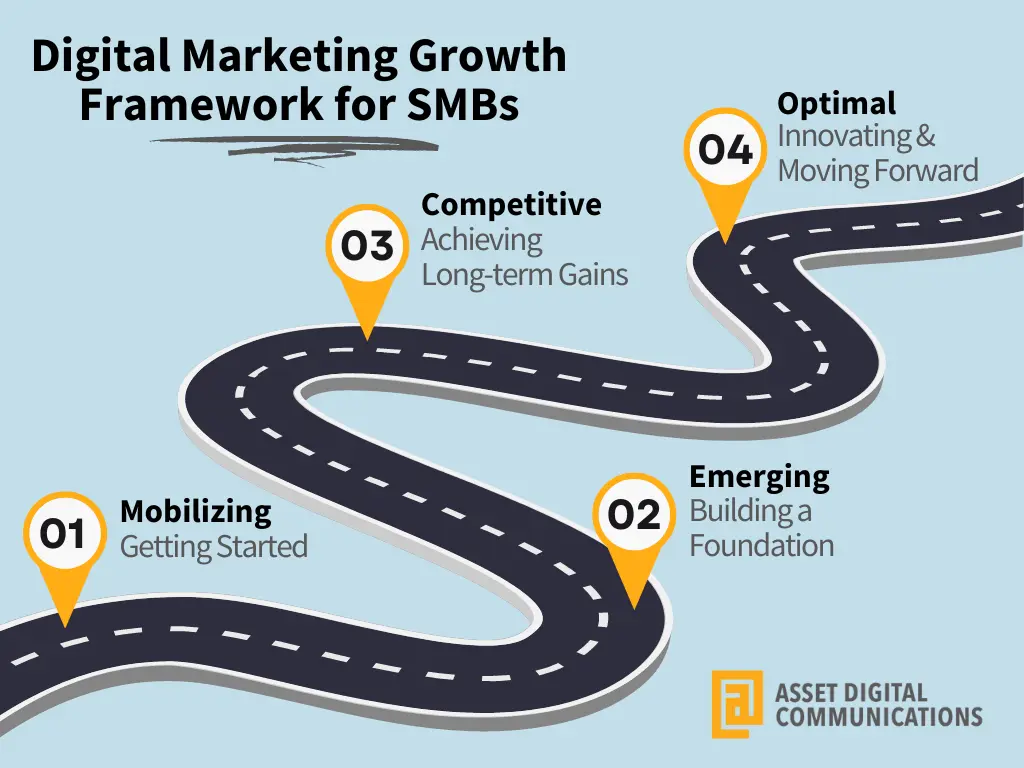
Our Digital Marketing Maturity Model
To begin your journey toward digital marketing growth, it’s essential to assess your current stage of digital marketing maturity. The digital marketing maturity model is divided into four stages, each offering unique opportunities and challenges.
Stage 1: Mobilizing – Getting Started
At this stage, your business is laying the foundation for its digital marketing journey. You’re exploring which channels, tools, and strategies fit your business goals while striving to create a cohesive online presence.
Key Questions You Might Be Asking:
- Which digital marketing activities will drive the most immediate and sustainable growth?
- How do I set a realistic budget, and what ROI can I anticipate?
- What tools should I use to measure and track success?
Impact of Mobilizing:
This phase focuses on building brand awareness and visibility. Businesses often prioritize creating a professional website, launching social media accounts, and producing basic content. Early efforts are geared toward ensuring that potential customers can find and interact with your brand online. While these activities might feel experimental, they set the stage for deeper engagement.
Role of an Agency:
A digital marketing agency provides crucial support by identifying your high-impact opportunities, and prioritizing tasks during the mobilizing stage. We can guide you in selecting the right platforms, crafting a beginner-friendly content strategy, and ensuring your website is optimized for search engines. Agencies can also assist with training your internal team to handle fundamental marketing tasks.
Measuring Success:
Measuring success during any digital marketing strategy is an important step to take. For B2B companies, success at the mobilizing stage might include generating initial website inquiries or securing your first leads through email campaigns. For B2C businesses, early metrics could involve building a social media following, growing an email list, or attracting traffic to your website through targeted ads.
Stage 2: Emerging – Building a Foundation
At this stage, your business has progressed beyond the basics and is starting to implement structured strategies. You’ve defined clear goals and have begun testing which digital marketing activities yield the best results.
Key Questions:
- How effective are we at evaluating performance over time (e.g., quarterly, annually)?
- What internal changes can we make to improve collaboration between marketing and other departments?
- Are our campaigns delivering measurable ROI, or do we need to refine our approach?
Impact of Emerging:
This stage is all about experimentation and optimization. Businesses begin leveraging performance data to refine campaigns and identify which efforts align best with their target audience. Investments in tools like customer relationship management (CRM) systems, email marketing software, and analytics platforms become more critical as you scale operations.
Role of an Agency:
An agency helps businesses establish a strong digital foundation by offering expertise in performance tracking, search engine optimization (SEO), and paid advertising. They’ll ensure your marketing budget is spent wisely and help you create data-driven strategies that deliver tangible results. Agencies can also implement scalable systems, such as marketing automation, to reduce manual work and improve efficiency.
Measuring Success:
For B2B businesses, success might involve increasing the volume of qualified leads and improving the sales funnel. For B2C, it could mean boosting conversion rates, driving e-commerce sales, or seeing an uptick in repeat customers.
Stage 3: Competitive – Achieving Long-Term Gains
By this stage, your business has established a consistent digital presence and sees steady results. The focus now is on amplifying success through advanced strategies and expanding your market share.
Key Questions:
- How can we use technology and data to create a 360-degree view of our customers?
- Are there untapped opportunities, such as new platforms or partnerships, that could accelerate growth?
- How are we differentiating ourselves from competitors in the digital space?
Impact of Competitive:
The Competitive stage is marked by advanced techniques, such as integrating multiple marketing channels, launching targeted campaigns, and leveraging automation to improve customer experiences. Personalized communication becomes a priority, with businesses tailoring messaging to individual customer needs. This stage also emphasizes retention, ensuring that customers remain engaged over the long term.
Role of an Agency:
Our agency can support scaling your efforts by introducing sophisticated tools like AI-powered analytics and creating omnichannel strategies that connect digital touchpoints. Agencies also play a key role in identifying areas for innovation and ensuring that campaigns are aligned with your business objectives.
Measuring Success:
For B2B, success might involve nurturing long-term client relationships through targeted campaigns and in-depth content like webinars or whitepapers. For B2C, metrics could include higher customer retention, increased lifetime value, and greater engagement with loyalty programs.
Stage 4: Optimal – Peak Performance and Innovation
At the Optimal stage, your business is a leader in digital marketing within your industry. Strategies are fully optimized, and efforts focus on staying ahead through innovation and continuous improvement.
Key Questions:
- What advanced skills and technologies can propel us to the next level?
- Are there internal barriers, such as outdated processes, holding us back?
- How do customers perceive our brand, and where can we improve to maintain loyalty?
Impact of Optimal:
Businesses at this stage have a seamless integration of all marketing channels, offering highly personalized and cohesive customer experiences. The focus shifts to exploring emerging technologies and strategies, such as AI-driven predictive analytics, voice search optimization, or augmented reality campaigns. Maintaining a competitive edge requires constant adaptation and a culture of innovation.
Role of an Agency:
Agencies help businesses at the Optimal stage by identifying trends and implementing cutting-edge technologies. They provide strategic guidance on how to refine existing campaigns, break into new markets, and continually delight customers with fresh and engaging experiences.
Measuring Success:
For B2B, success might mean being recognized as an industry thought leader and securing high-value partnerships. For B2C, it could involve turning customers into brand advocates and achieving unparalleled customer satisfaction.
Asset Digital Communications Digital Marketing Maturity Assessment
| This Digital Marketing Maturity Assessment will help your business navigate toward greater maturity and profitability |
How Can Our Digital Marketing Strategy Framework Help Your Business?
Asset Digital Communication’s Digital Marketing maturity model includes a powerful assessment tool designed to empower SMBs with a structured and results-driven approach to digital marketing. Whether your business is just starting out or looking to fine-tune its existing strategies, the framework delivers key advantages to help you achieve sustainable growth:
Clarity
One of the biggest challenges SMBs face in digital marketing is knowing where to start or where to focus their efforts. This framework helps you identify your current stage, assess the strengths and weaknesses of your existing strategies, and determine the best next steps forward.
By breaking down digital marketing growth into manageable phases, this framework provides a clear roadmap that reduces guesswork and aligns with your long-term business objectives.
Efficiency
With limited resources, SMBs need to ensure every marketing dollar and hour spent delivers maximum impact. The framework emphasizes prioritizing activities that generate the highest ROI for your business, helping you focus on what works.
By optimizing processes, leveraging automation, and aligning efforts across channels, it reduces wasted time and effort, allowing you to scale your marketing without stretching your resources thin.
Competitiveness
The digital landscape is constantly evolving, and staying ahead of competitors requires more than just keeping up—it demands a proactive approach. By incorporating data-driven strategies, the framework ensures that your marketing evolves with industry trends. From using analytics to uncover customer insights to implementing innovative technologies, the framework positions your business as a leader in your space.
Tailored Support for Your Business Needs
Every business is unique, and a one-size-fits-all solution won’t cut it. That’s why Asset Digital Communications takes the results from your assessment, and together with your business, we map out a unique plan. We customize your strategy framework and plan in order to fit your specific goals, challenges, and your industry. Our team works closely with you to design the critical next steps that align seamlessly with your vision for growth.
By adopting this strategy framework, your business gains a strategic advantage. It empowers you to make informed decisions, maximize your marketing potential, and build a strong foundation for future success.
Ready to Accelerate Your Digital Marketing Growth?
The journey to digital marketing growth begins with understanding your maturity stage and providing your business the priority actionable steps put your company on both a growth and maturity trajectory. At Asset Digital Communications, we are experts in guiding SMBs to stronger online market share, growth and profitability with expert insights and tailored strategies for your business.
Take the next step today with our digital marketing maturity assessment. Let us help you craft a personalized roadmap to greater profitability and sustained growth.
| What is holding back your business growth? Take this assessment to discover fresh new avenues for growth! |
